Întrebați despre carteRăspundem imediat
Salut! Te ajut să afli dacă ți se potrivește „Between Wasteland and the Grail - Cristina». Întrebați 👇
 94

Capodoperă literară
Evaluarea redacției
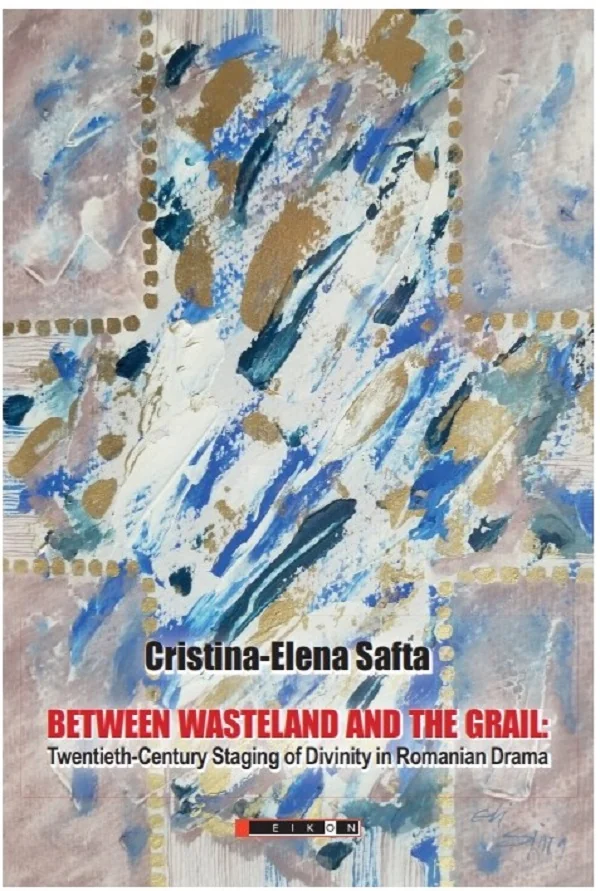
Between Wasteland and the Grail - Cristina-Elena Safta
47 lei
În stoc — gata de expediere
Editura: EIKON
ISBN: 9786064905994
Întrebați despre carteRăspundem imediat
Salut! Te ajut să afli dacă ți se potrivește „Between Wasteland and the Grail - Cristina». Întrebați 👇
🏛 EIKON
ISBN: 9786064905994
📝 Descrierea cărții: Between Wasteland and the Grail - Cristina-Elena Safta
Between Wasteland and the Grail: Twentieth-Century Staging of Divinity in Romanian Drama \n Editie in limba engleza. \n \n It rarely happens that an author's first book, even when based on a doctoral thesis, should display both multiple hermeneutic skills and the difficult enterprise of theorizing and conceptualizing the object of investigation, while also covering previous exegetic exercises both with a critical eye and an heir's deference to intellectual legacy. Although the analysis goes down to the lexical and etymological level of the texts, the assumption of a methodology and its consistent application remains an imperative considered throughout the book. In accordance with current practice, Cristina Elena Safta combines several methods. The studies of representation seemed to come in handy, especially in the manner of the cultural materialism from Birmingham represented by Edward Hall, to which was added Foucault's and Vito Pandolfi's New Historicism, out of whose combination rose the critical theory known as cultural studies. Unlike classical historical theatre, understood as a succession of paradigms, New History studies the past as a succession of styles, the double past/ present perspective relativizing their distance in time. Looked at in this perspective, the succession of epistemic matrices from the early Middle Ages to the present day corresponds to three almost contemporary paradigms. The medieval, theocratic vision of the history of humanity cast in the mould of biblical history from the Genesis to the Last Judgment is identified in Valeriu Anania's plays. The deconstruction of this paradigm has taken centuries of real history. The stages covered along this timespan are classified in a way that proves disciplinary culture. In Renaissance drama, exemplified by Lope de Vega, the place of God in whose eye man is playing his part in the cosmic script is taken by the creative artist, while the eighteenth century relativizes the notion of divinity which becomes a concept, a human construct. Transcendence becomes possible again with the advent of studies on the subconscious. In Lucian Blaga's case, the author discusses both the role of unconscious stylistic categories, linking them up with the later unconscious stylistic matrix in Lyotard's Discours, figure (1971), and the anticipation of the genesis of Heidgger's work (Der Ursprung des Kunstwerkes, 1950), the Manole / Mira / Gaman / church foursome being really analogous to the Heideggerian tetrad that brings together in the work of art divinity (revealed in Manole's subconscious), mortals (Mira), earth (Gaman) and heaven (church). Finally, the semiological aesthetics after the war is illustrated by the author through the self-reflexive drama of Marin Sorescu. The deconstruction of divine logocentrism in nature proliferating chaotically as in The Saxton is pitted against the construction of the figure of the artist in Jonah, where the protagonist no longer carries God's message to humans, but his own message, word and memory, which save him from the leviathan of amorphous nature. The definition of three poetics in relation to cognitive matrices associated with the three epochs - religious premodernity, oriented towards transcendence, epistemology-oriented modernity, and postmodernity dominated by semiology - already involves discourse analysis, both in the study of cognitive values and power relations in the dramatic universe. However, the author uses this interdisciplinary p
📊 Caracteristici
Tabelul caracteristicilor
| Editura | EIKON |
|---|---|
| ISBN | 9786064905994 |
⭐ Recenziile cititorilor
Scorul inițial a fost acordat de echipă Mirava — adăugați-o pe a dvs. →
Scorul cititorilor
Nu există încă recenzii. Fiți primul!
Ați citit această carte?
Recenzia dvs. îi va ajuta pe alții să aleagă — iar dvs. veți primi reducere de 10% pentru următoarea carte
−10%
la următoarea comandă
⏰ Va dura 2 minute
🎫 Codul apare imediat pe ecran
😊 Reducere pentru orice recenzie
🛡️ Nu ștergem criticile
Acordăm reducerea pentru orice recenzie — pozitivă sau critică. Codul este valabil 60 de zile pentru comenzi de peste 200 lei. Marcăm separat recenziile pentru care s-a oferit o reducere.


Aveți o întrebare despre produs?
Puneți o întrebare — un responsabil vă va suna sau vă va scrie, iar răspunsul va apărea aici, pe pagina produsului.